






































































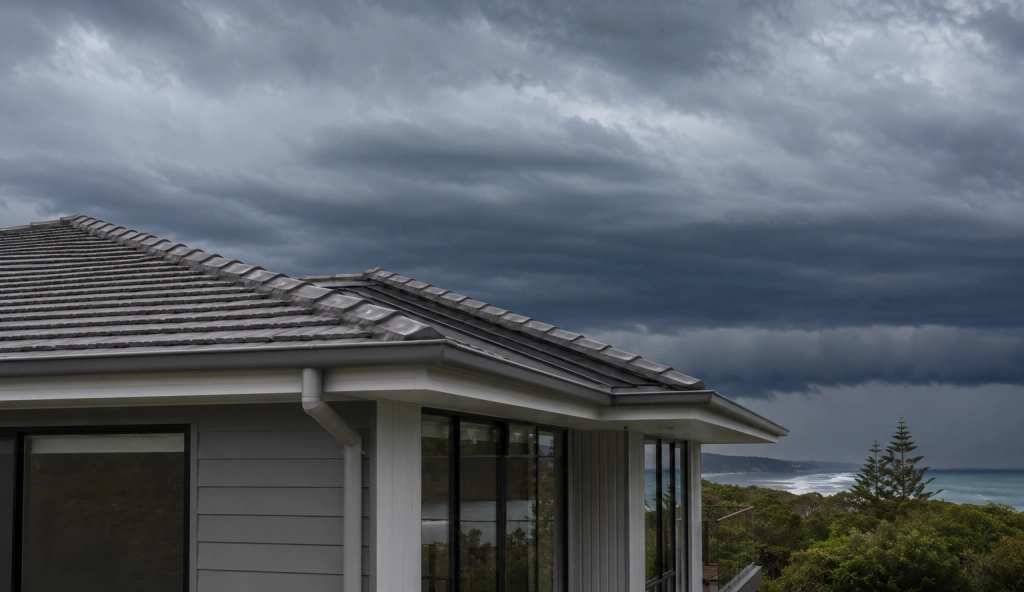
There’s a particular sound a Sydney storm makes when it means business — the wind shifts, the light goes green-grey, and about forty seconds later the rain hits sideways. If your roof, gutters and drains are in good shape, you make a cup of tea and watch it. If they’re not, you spend the night with a bucket under the ceiling and a torch in your teeth.
The difference between those two nights is usually a couple of hours of preparation done weeks earlier, on a dry afternoon, while everything was calm and easy to reach. That’s what this guide is about. Not fear, not a hard sell — just the handful of things worth checking before the weather turns, and an honest steer on which jobs you can do yourself and which ones are best left to someone with a harness and a ladder they trust.
Why the coast cops it harder
Anyone who’s lived through a southerly buster, a Central Coast downpour or a Newcastle East Coast Low knows the drill. The rain doesn’t fall so much as arrive, all at once, and it finds gaps you didn’t know you had. Drainage that copes perfectly well for eleven months of the year suddenly can’t keep up, and water starts going places it was never meant to.
The main thunderstorm season across eastern NSW runs roughly October through March, but don’t file storm prep under “summer only.” The coast gets hammered by East Coast Lows in the cooler months too, so the sensible habit is a quick check before any stretch of nasty weather, whenever it lands on the forecast.
Living near the water adds its own wrinkles. Salt in the air chews through metal roofing, flashing and screws faster than it does inland. A lot of the older streets — from the Northern Beaches down through the North Shore and up around Newcastle — carry ageing tiled roofs and clay or cast-iron drainage that groan under a sudden dump. And if you’ve got big trees, one windy week can pack a gutter solid with leaves.
The good news, and it’s worth holding onto: most storm damage is preventable. The prep costs a fraction of the repair. You just need to know what to look at, roughly in what order, and where your own limits sit.
Start where the water starts: the roof

Your roof takes the first hit and it’s the dearest thing to get wrong. One lifted tile or a bit of loose flashing can let a genuinely alarming amount of water into your ceiling during a heavy fall.
You can learn a lot without leaving the ground. Grab a pair of binoculars and have a proper look. Cracked, slipped or missing tiles tend to show up along the ridgelines and in the valleys. On a metal or Colorbond roof, keep an eye out for rust streaks, sheets that have started to lift, or screws working their way loose. Flashing is a common troublemaker — check where it meets chimneys, skylights, vents, and the join where the roof runs into a wall. A section that looks like it’s sagging can mean trapped moisture or tired timber underneath, and debris caught in the valleys is quietly damming water and pushing it back under the tiles.
Then pick a dry day and stick your head into the roof cavity with a torch. Water stains on the underside of the sarking or timber, damp insulation, or a shaft of daylight where there shouldn’t be one — any of those means the roof is already letting go somewhere.
Here’s the part I’d underline if I could only tell you one thing: stay off the roof. Especially if it’s wet, steep, or you’re not fully confident and properly kitted out. Falls from height put people in hospital every year, and a roof in the rain is about the worst version of that risk. This is genuinely a job for someone with the right gear and the experience to move around up there safely. If your ground-and-cavity check turns up anything that worries you, book a proper inspection rather than gambling on it.
The whole reason to look early is timing. A cracked tile sorted in September is a ten-minute, cheap fix. Leave the same tile until a March storm and you’re looking at a soaked ceiling, ruined insulation, and a mould problem that hangs around long after the sky clears. If you’ve spotted any of those warning signs — or you’ve had a leak before and never quite trust it — professional roof leak detection and repair will track down where the water’s getting in and seal it before the next front arrives.
The gutters — the job everyone puts off
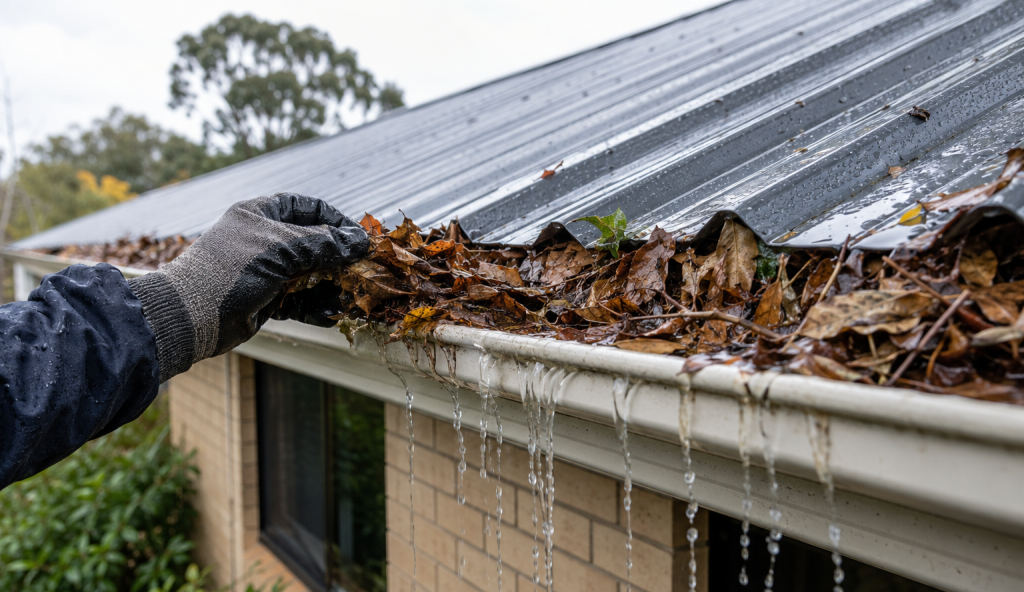
If there’s one thing that gets skipped, it’s the gutters, and they’re exactly the thing most likely to bite you. When a gutter’s blocked, the rain has nowhere to go but over the front edge and down your walls — or, worse, back up under the roofline and into the ceiling.
You’ll usually get plenty of warning if you’re paying attention. Plants or moss actually growing out of the gutter is a dead giveaway that there’s a compost heap up there. Water sheeting over the edge in only moderate rain is another. So are gutters that sag or pull away from the fascia, rust and splits at the joints, and downpipes that gurgle, overflow at the top, or stay eerily silent when they ought to be running hard.
And it’s not just about the roof. All that overflow pools around your foundations, works its way into wall cavities, rots the timber fascia and eaves, and undermines paths and garden beds. On a two-storey place, the sheer volume a full gutter dumps in the wrong spot during a storm is something to see — and not in a good way.
Plenty of people are comfortable clearing an accessible single-storey gutter themselves, and fair enough. But the height warning still stands: a ladder on soft, wet ground is no joke, and second-storey work is best handed over. The repairs matter too — a sagging run, a corroded section, a joint that’s given up — because a patch that fails halfway through a storm has done you no favours at all. Getting the gutter cleaning and repair sorted before the season is about the best value, lowest-drama job on this whole list.
While you’re at it, follow your downpipes down and make sure they’re actually emptying where they should — into the stormwater system or a proper legal outlet, not just puddling at the base of a wall. A cracked or disconnected downpipe quietly tips hundreds of litres straight into your foundations every time it rains, and nobody notices until something moves. Supply-side leaks behave the same way — here’s why a water bill suddenly spikes.
Where does all that water go?
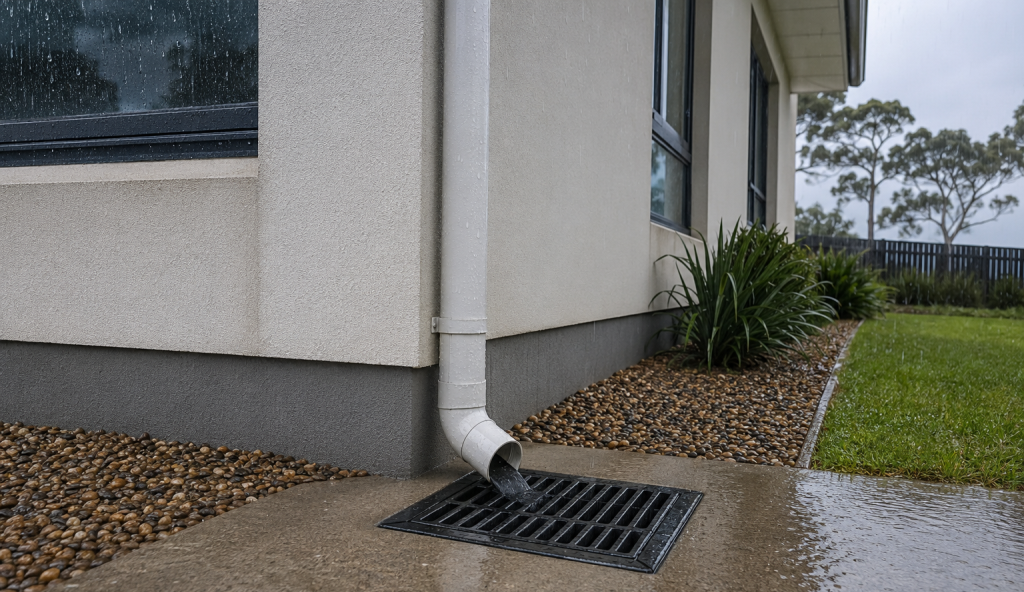
Once the water’s off your roof and down the pipes, it needs somewhere to run. That’s your stormwater drainage, and when it’s blocked it backs up at precisely the moment you’d least like it to.
The tells are pretty consistent. Water pooling in the yard or against the house long after the rain’s stopped. Pits or grates overflowing mid-storm. That gurgle from drains and downpipes when they’re under load. Water welling back up out of an external drain near a path, the garage or under the house. A musty smell hanging around the low points of the block.
Leaves and silt are the usual offenders, but on an established coastal block the real menace is tree roots. They sniff out moisture, find their way into a pipe joint, then swell and snag debris until the whole line chokes. It’s one of the most common reasons a drain that behaved itself for years suddenly can’t handle a decent downpour.
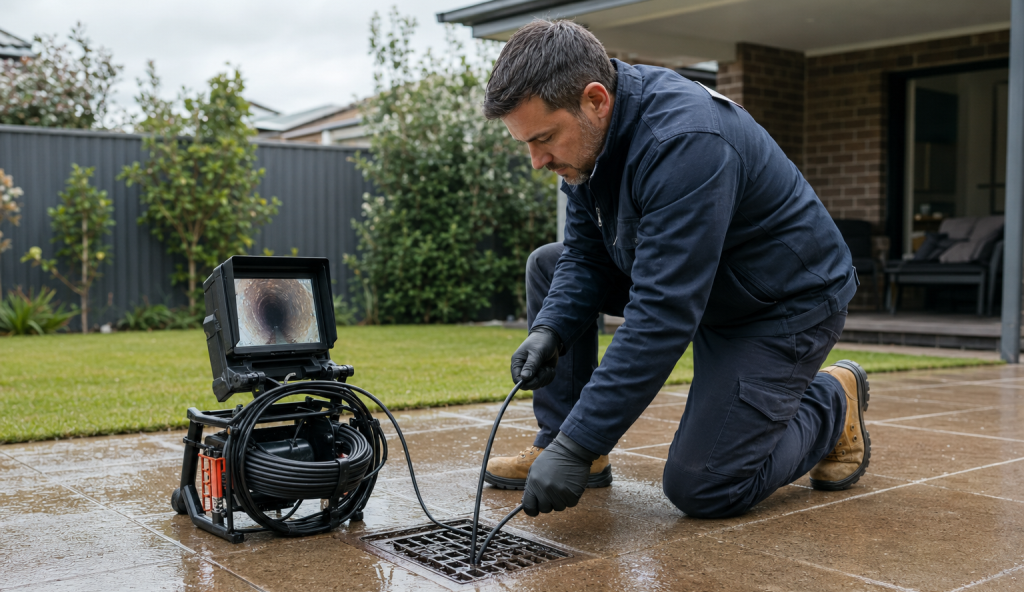
You can keep the surface grates and pits clear yourself easily enough. Anything below ground, though, wants the right gear — a camera down the line to find the actual blockage, then a high-pressure jet to clear it, rather than poking about and hoping. If your place has form for pooling or backing up when it rains hard, booking stormwater drain cleaning ahead of the season clears the line properly and tells you whether roots or a cracked pipe are the real story underneath.
Storms and electricity: leave this one to the professionals

This is the part to take seriously without overthinking. Lightning, power surges and water getting where it shouldn’t can all damage wiring, appliances and your switchboard — and create real safety hazards along the way.
Before the season kicks off, it’s worth having a licensed electrician cast an eye over your switchboard — and if you’re unsure whether the job needs specialist qualifications, it’s worth knowing the benefits of hiring a Level 2 electrician. A lot of older homes around Sydney, the Central Coast and Newcastle are still running boards without modern safety switches, which are your main line of defence against a shock if water reaches wiring or an appliance faults during a storm. Surge protection is worth a conversation too — one good surge can knock out a fridge, a TV, a computer and your hot water system controller in a single hit. If your board is already due for work, it can be a sensible time to ask about a smart meter upgrade as well.
What you should never do is open the switchboard, fiddle with fixed wiring, or attempt any electrical repair yourself. It’s licensed work for a reason, and in the wet the risk climbs.
If a storm does cause an electrical problem — a burning smell, sparking, a power point that’s copped rain, or wiring left exposed by fallen debris — keep well clear and keep everyone else clear too. If it’s safe and you know how, switch the power off at the main. Never go near a fallen powerline or anything touching one; call Triple Zero and your electricity network provider. Once the danger’s passed, get a licensed electrician in to inspect and repair. Treat anything like this as urgent, because water and electricity really don’t mix, and what looks minor can be genuinely dangerous.
The little gaps that let water in
Beyond the big three, a few small checks close off the sneaky routes water uses to get inside. Run your eye over the seals on windows and doors, especially on the weather side — driving rain will find any gap you’ve missed. Skylights are a classic weak point once the seal ages; if one has ever wept in heavy rain, get it looked at now rather than during. Seal up any fine cracks in walls or render while it’s dry, because wind-driven water uses them like a straw.
Then there’s the stuff that isn’t part of the house at all. Outdoor furniture, the trampoline, umbrellas, bins, a shade sail — in strong wind these turn into projectiles, so have a plan to store or tie them down quickly when a warning comes through. And if you’ve got big branches hanging over the roof, get a qualified arborist to assess and prune them well before the season. A large limb through the roof is a very bad night.
Have a plan for the storm itself
Prep isn’t only about the building. Knowing what to do when it actually hits makes a real difference, and it doesn’t need to be complicated.
Know where your main water stop tap, gas isolation valve and switchboard main switch are, and how to shut them off safely — not something you want to be working out by torchlight. Keep a torch, a charged phone and your tradesperson’s number somewhere you’ll actually find them. Follow the NSW SES, and remember you can call them on 132 500 for storm and flood damage like a hole in the roof or a tree down; Triple Zero is for life-threatening emergencies.
If water starts coming through the ceiling, don’t stand under a bulging patch of plasterboard — it can hold a frightening amount of water and let go all at once. Keep clear, stay away from light fittings and power points, and if it’s safe, set a container to catch the drips away from anything electrical. And whatever you do, stay off the roof during the storm and straight after. Wet, damaged roofing is one of the most dangerous surfaces there is.
Once it’s passed

When the weather clears and it’s genuinely safe to move around, do a calm walk-around at ground level. Photograph anything that’s obviously taken a hit — lifted tiles, dented sheets, displaced flashing, mangled gutters, branches down — because your insurer will want to see it. Head inside and check the ceilings and cornices for fresh stains, sagging or drips. Look for pooling water and any drains that clearly didn’t cope, and note anything odd with the power: flickering, tripped circuits, appliances that got wet.
Same rule as before — don’t climb up to inspect the roof yourself. If there’s clear damage or a live leak, that’s exactly when the professionals earn their keep. Emergency roofing and plumbing crews can make a place safe and watertight fast, then come back and do the repair properly once the immediate risk is handled. Getting a leak sealed quickly also spares you the second wave of damage — the soaked insulation, the warped timber, the mould — which very often costs more than the original problem ever would have. Where water has soaked carpets or underlay, acting fast matters there too; professional carpet cleaning can lift moisture before it turns into a mould problem.
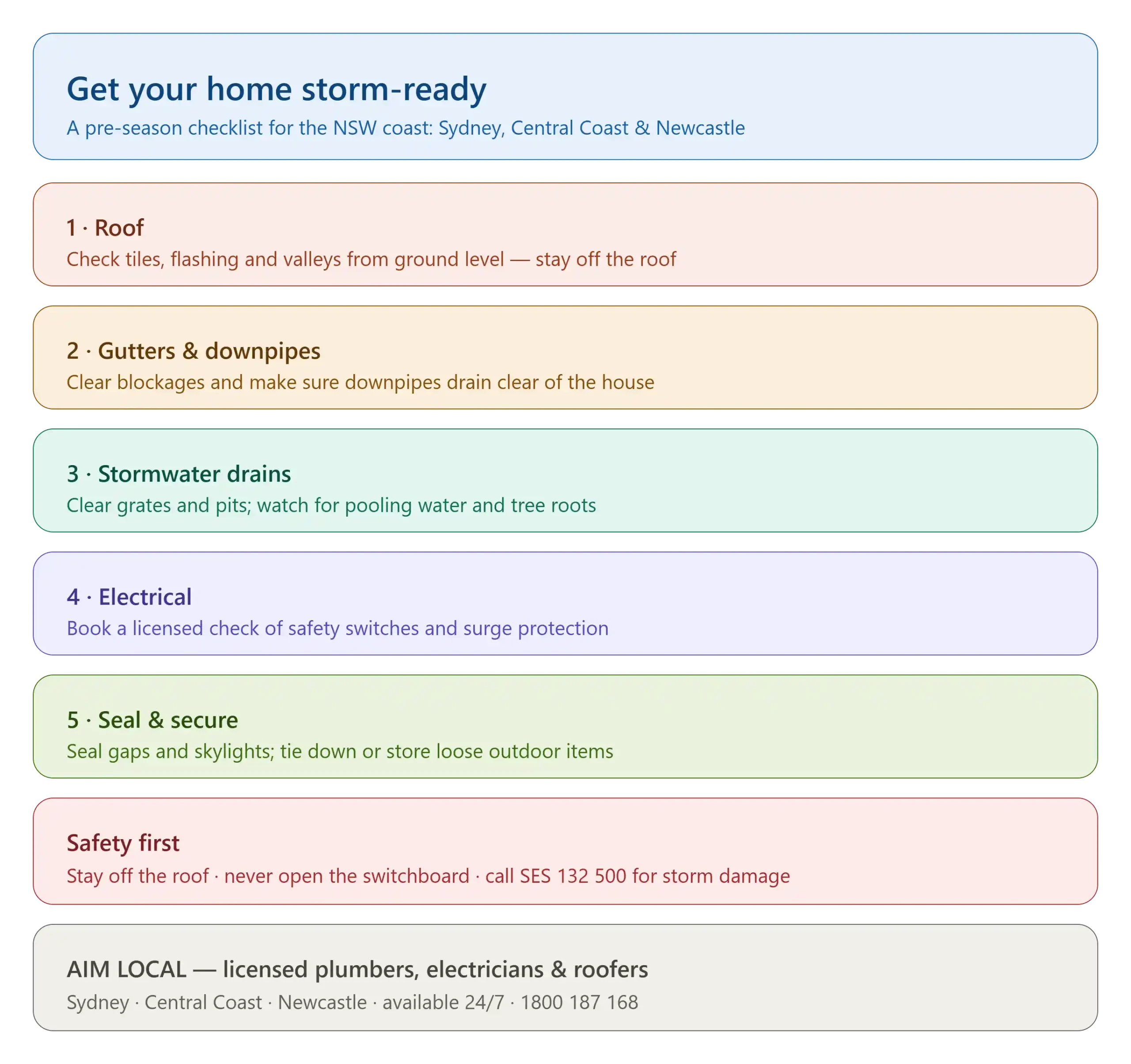
A quick checklist to work through
If you’d rather just have the short version to tick off on a dry afternoon:
- [ ] Check the roof from the ground and from inside the cavity
- [ ] Clear the gutters and confirm the downpipes empty where they should
- [ ] Fix any sagging, rusted or leaking guttering
- [ ] Clear surface stormwater grates and pits, and think about any pooling history
- [ ] Have a licensed electrician check the switchboard, safety switches and surge protection
- [ ] Seal window and door gaps, and check the skylights
- [ ] Secure or store loose outdoor gear before warnings hit
- [ ] Prune overhanging branches with a qualified arborist
- [ ] Find and learn to safely isolate your water, gas and power
- [ ] Save your tradesperson’s number and the SES line (132 500)
If you look after rentals or strata
For landlords and property managers, storm season carries extra weight — more roofs, shared drainage, and tenants who quite reasonably expect a fast, documented response. The principles don’t change, they just scale up. Book roof and gutter inspections across the portfolio before the season, keep records of what was checked and when, and have a trade contact you trust who can attend several properties and report back clearly. A round of preventative maintenance is almost always cheaper and far less painful than a string of emergency call-outs across one wet fortnight — and it protects the buildings and the relationships at the same time. The same year-round thinking applies to other risks; here’s how to keep a Sydney property maintained through the seasons.
A few common questions
When should I actually start preparing? Get the roof, gutters and drains checked before the severe season builds from around October, then again ahead of any run of heavy weather. The coast gets big storms outside summer too, so a look before a bad forecast never goes astray.
How often do gutters really need doing? Twice a year suits most homes. If you’ve got trees overhead — common right across the North Shore, the Central Coast and the leafier parts of Newcastle — you’ll likely need them cleared more often, especially heading into the season.
Can I check my own roof? Looking from the ground and from inside the cavity is genuinely worth doing. Actually climbing onto the roof isn’t recommended, particularly when it’s wet or already damaged. That part’s a job for a professional with the right safety gear.
Water’s coming through the ceiling mid-storm — what now? Keep away from any bulging plasterboard, stay clear of electrical fittings, and contain the drips if it’s safe. Switch off power to the area if you know how, and get an emergency roofer or plumber onto it. For serious damage, the SES (132 500) can help make the property safe.
Will insurance cover it? That comes down to your specific policy, so check with your insurer. Photos of the damage and records of any maintenance you’ve done can help support a claim. This is general information, not insurance advice.
Get ahead of it
A couple of hours now buys you a much quieter night later in the season. If your roof, gutters or drains could use a professional eye — or a storm’s already done some damage — AIM LOCAL handles licensed plumbing, drainage, electrical and roofing work across Sydney, the Central Coast and Newcastle, with 24/7 emergency cover and upfront pricing. Book a pre-season inspection or call for urgent help on 1800 187 168.