



































































There’s a particular kind of problem that gets quietly ignored in property management: the gutters nobody can easily see. On a single-storey house, a blocked gutter is obvious within a season — water spills over the edge, a stain appears on the render, someone calls a tradie. On a multi-storey office block or a strata complex, blocked gutters sit quietly on rooflines twelve metres up, doing damage that doesn’t show up until something fails badly enough to be undeniable.
The tools used to deal with those two situations are very different, and this is where commercial and residential property maintenance part ways significantly. Standard gutter cleaning — the kind involving a ladder, a bucket, and someone scooping debris by hand — was never designed for large commercial roofs, box gutters, or buildings where height safety turns a routine job into a complex one. Industrial gutter vacuuming exists precisely because those properties have different requirements, different risks, and different consequences when things go wrong.
The Difference Between a House and a Commercial Roof
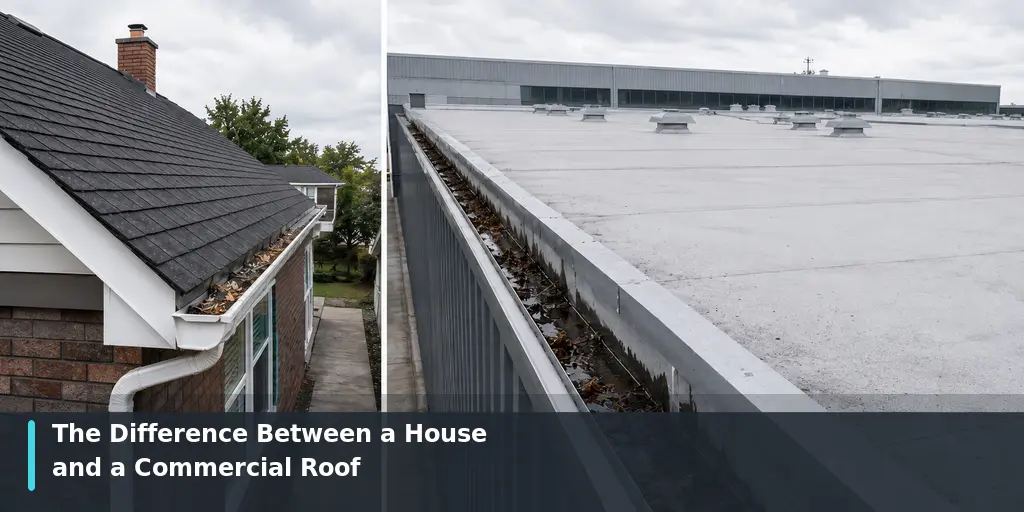
To understand why the method matters, it helps to think about what a commercial or multi-storey roof is actually dealing with.
A typical Sydney home might have 15 to 20 linear metres of gutter channel. A medium-sized strata complex — say, a four-storey block of 20 apartments — can have several hundred metres of gutter across multiple roof levels, box gutter sections, valley drains, and downpipe junctions. An office building, a school, or a shopping centre adds more complexity again: flat roof sections, internal box gutters that drain into the building rather than over the edge, and roof catchment areas measured in thousands of square metres.
Box gutters are where poor maintenance tends to hurt the most. Unlike fascia gutters on a house that overflow downward and outward, a box gutter sits inside the roofline and drains into the building structure. When one gets blocked and water overtops it, that water doesn’t fall harmlessly to the ground. It finds its way into the building fabric — through ceilings, into wall cavities, onto electrical systems, or across floors that tenants are still actively using.
A single blocked downpipe junction in a box gutter on a Sydney CBD office block during an east coast low event isn’t a minor maintenance issue. It can become a significant liability.
Why Manual Cleaning Falls Short on Large-Scale Properties
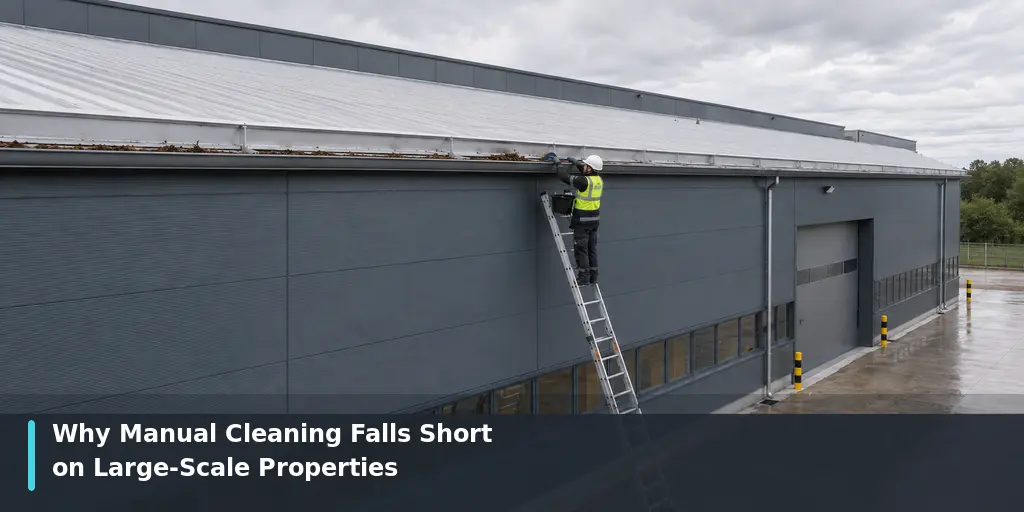
The traditional approach to gutter cleaning — ladders, blowers, and manual scooping — works reasonably well on straightforward residential jobs. It was designed for that context. When you move it into a commercial or multi-storey environment, the limitations stack up fast.
Access is the first problem. The SafeWork NSW working at heights regulations are clear: anything above two metres requires proper risk controls. For the top floors of a four-storey strata building, that means either scaffolding, a cherry picker (elevated work platform), or rope access — none of which is cheap or quick to organise. Meanwhile, manual cleaning at those heights, even with the right equipment, is inherently slow because the work is done by hand, one section at a time.
The second problem is mess and thoroughness. A manual clean on a large roof will often disturb debris without fully removing it. Blowers push leaves off gutters and onto adjacent surfaces, pathways, or neighbouring properties. Hand scooping gets the bulk of it but leaves behind the compacted silt, seed material, and fine organic matter that settles at the bottom of the gutter channel — exactly the stuff that rots the gutter from the inside and blocks the fine slots at downpipe entries.
On a commercial property where tenants, customers, or residents are present, there’s also the disruption factor. Scaffolding going up around a strata block for a gutter clean isn’t something that can happen unannounced on a Tuesday morning. It needs planning, notice periods, and coordination with the owners corporation.
What Industrial Gutter Vacuuming Actually Involves
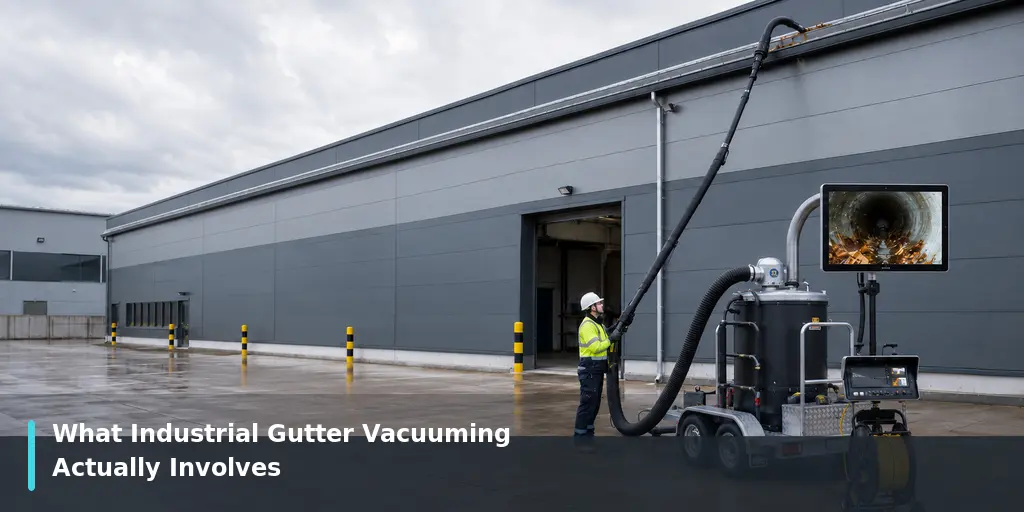
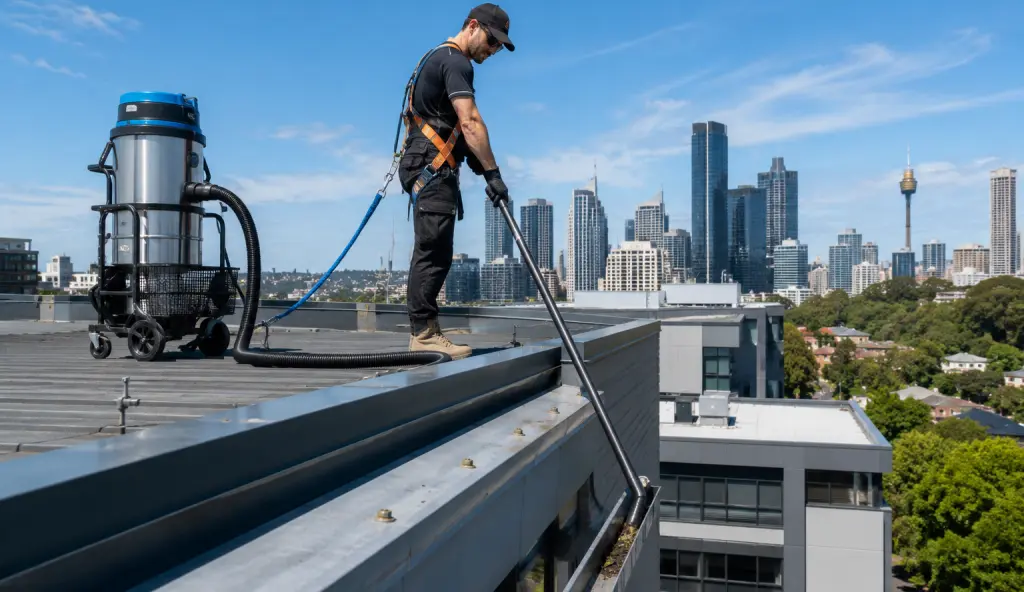
Industrial gutter vacuuming is a ground-based or platform-based operation that uses high-powered suction equipment — significantly more powerful than any domestic vacuum — combined with carbon fibre extension poles that can reach gutters on three-storey buildings without the operator needing to be at roof height.
The debris, water, silt, and organic matter is pulled directly from the gutter channel into a sealed collection tank on the vacuum unit. Nothing is blown around, nothing falls onto pathways or vehicles below, and the process reaches the bottom of the gutter channel in a way that hand scooping rarely does. For compacted wet leaf matter, bird nesting material, and the heavy silt that NSW storms leave behind, the suction method pulls it out in one pass rather than loosening it and hoping it drains away.
For buildings that are too tall or have complex roof access requirements, the vacuuming approach is combined with rope access or elevated work platforms — but the key advantage is that the actual cleaning still happens via suction rather than manual handling, which keeps the job faster and the mess contained.
On multi-level commercial properties, a well-equipped industrial vacuum service will also carry camera inspection equipment that can be run through downpipes to verify they’re clear all the way through — something that hand cleaning simply can’t confirm.
The Compliance Dimension That Property Managers Can’t Ignore
For strata committees and commercial property managers in NSW, gutter maintenance isn’t just a practical question. It has legal dimensions that are worth understanding clearly.
Under section 106 of the Strata Schemes Management Act 2015, an owners corporation is legally required to properly maintain and keep common property in a state of good and serviceable repair. Roofs, box gutters, fascias, downpipes, and stormwater connections are almost always common property in a strata scheme. If the owners corporation fails to maintain them and water ingress damages a lot owner’s property, that lot owner has grounds to apply to NCAT for damages. The tribunal has consistently treated water ingress from neglected drainage as a clear section 106 failure.
For commercial property managers, the liability exposure runs through insurance policies. Most commercial building insurance policies contain maintenance exclusions — if water damage can be attributed to a gutter that hadn’t been cleaned within a reasonable schedule, the insurer has grounds to reduce or reject the claim. A documented maintenance history, with dated records, photographs, and contractor reports, is what separates a valid claim from a disputed one.
This is where the documentation that comes with a professional industrial vacuuming service matters practically. A proper commercial gutter service should deliver a photo and video site report after every job, a compliance statement against the relevant AS/NZS 3500.3 plumbing and drainage standards, a waste disposal record, and a Safe Work Method Statement showing how height safety obligations were met. This file is exactly what an insurer or tribunal wants to see when reviewing whether a building was properly maintained.
Strata Managers: What a Good Maintenance Schedule Looks Like
For strata complexes in Sydney, Central Coast, and Newcastle, the most effective approach isn’t simply reacting when a gutter overflows. It’s scheduling regular cleans around the conditions that actually drive gutter blockages in NSW.
The pattern that tends to work well is two cleans per year: one in late autumn, after the deciduous leaf drop has finished, and one in spring, clearing the summer silt and debris load before the storm season builds from November onwards. Properties surrounded by eucalypts, she-oaks, or large deciduous trees may need three visits.
The autumn clean is the one that matters most for strata. NSW east coast low events tend to concentrate in the June-to-August window, and a complex heading into that period with gutters clogged from autumn leaf drop is a significant water damage risk. Getting gutters cleared in April or May, before that window opens, is basic risk management.
Between those scheduled cleans, a visual inspection after any major storm event — checking for obvious overflow staining on the building facade or water marks on ceilings near the roofline — takes five minutes and can flag problems before they compound.
Specific Challenges for Commercial Buildings in Sydney, Central Coast and Newcastle
Each of these regions has its own conditions that make commercial gutter maintenance more demanding than it might seem on paper.
Sydney’s CBD and inner suburbs see the “canyon effect” — wind funnelling through the gaps between buildings deposits debris onto higher rooftops that would otherwise be relatively sheltered. Properties near Harbour, coast, or estuaries deal with salt air accelerating gutter rust, which means corrosion that would take a decade to develop on an inland building can appear in three or four years. Industrial vacuuming doesn’t just clean a corroding gutter — a thorough service will flag where repairs or replacement sections are needed before they become structural failures.
The Central Coast and Newcastle regions have significant tree cover in their commercial precincts. School buildings, aged care facilities, and office parks surrounded by mature eucalypts are dealing with continuous debris loads — not just in autumn, but year-round, since native trees shed bark, seeds, and leaves across every season. For these properties, a once-a-year clean is usually insufficient, and the industrial vacuum method is the only practical way to handle the volume quickly enough to minimise business disruption.
For aged care facilities and schools specifically, the operational window for maintenance is narrow — work needs to happen outside business hours, in a quiet and orderly way, without equipment creating hazards in areas where vulnerable people are present. Industrial gutter vacuum equipment fitted with mufflers is significantly quieter than scaffolding and hand-cleaning operations, which matters when you’re working around a facility that can’t simply close for the day.
A Practical Note on Choosing the Right Contractor
Not every gutter cleaning business is set up to handle commercial work properly. A contractor who handles residential jobs competently may not carry the right equipment, the right insurance levels, or the height safety accreditation that large commercial properties require.
Before booking any commercial gutter service, it’s worth asking: Are they licensed for the work involved? Do they carry public liability insurance at a level appropriate for commercial properties? Can they supply a Safe Work Method Statement specific to the site? Will they provide a documented report after the job, including photographs?
For strata committees, it’s also worth checking whether the contractor’s workers’ compensation coverage is current — if a worker is injured on the property and the contractor’s insurance is lapsed or insufficient, the liability exposure can fall back on the owners corporation.
A contractor who handles large-scale commercial and strata work routinely will answer all of these questions without hesitation and will have the documentation ready before the job starts. One who isn’t set up for it properly will find reasons to sidestep the question.
The Bottom Line
Large buildings are not just bigger versions of houses. Their drainage requirements are different in scale, their height safety obligations are more demanding, and the consequences of deferred maintenance are more serious — for tenants, for insurers, and for the owners or managers who carry legal responsibility for common property.
Industrial gutter vacuuming isn’t a luxury option for commercial and multi-storey properties. For buildings of any significant size, it’s the method that matches the job: ground-based where possible, thorough enough to pull silt from the base of the channel, documented properly for compliance purposes, and fast enough to work around the operational demands of an occupied building.
If you manage a strata complex, a commercial property, or a multi-storey building in Sydney, the Central Coast, or the Newcastle region, it’s worth having that conversation with a contractor who actually specialises in this type of work — not just one who cleans gutters on weekends with a ladder and a bucket.
This post is written by GutterFlow team.