







































































What the Renters’ Rights Act Means for Essex Landlords in 2026
A practical guide for landlords in Havering, Brentwood and the Essex commuter belt
If you let a property anywhere in Havering, Brentwood or the wider Essex commuter belt, the rules you let under have changed more this year than at any point in a generation. The Renters’ Rights Act received Royal Assent in October 2025, and the bulk of its tenancy reforms came into force on 1 May 2026. It replaces a framework that had governed private renting since the Housing Act 1988, and whether you own a single flat or a small portfolio, it pays to understand what has actually changed rather than working from headlines.
This is a practical, plain-English rundown written from a local letting perspective. It covers what is different, what it means day to day, and where the risks now sit for landlords in Essex.
A note on accuracy: the rules, dates and figures below are correct as at July 2026. Legislation of this size is still being clarified through guidance and secondary regulation, so always confirm the current position on GOV.UK, or take advice, before serving any notice or relying on a specific figure.
A quick summary of what changed
Before getting into the detail, here is the shape of it — the old system on one side, the new one on the other.
| Area | Before 1 May 2026 | From 1 May 2026 |
| Tenancy type | Assured shorthold tenancy (AST), usually a 6 or 12 month fixed term | Periodic assured tenancy — rolling, monthly, no fixed end date |
| No-fault eviction | Section 21 notice, no reason needed | Abolished — possession only via a valid Section 8 ground |
| Ending a tenancy (tenant) | Bound until the end of the fixed term | Can leave any time on two months’ notice |
| Rent increases | Often set in the tenancy agreement | Once every 12 months only, via Section 13, challengeable at tribunal |
| Rental bidding | Common in high-demand areas | Banned — you must advertise a set asking rent |
| Rent in advance | Large sums frequently requested | Restricted once the tenancy is entered into |
| Pets | Landlord’s discretion | Tenant can request; you can’t unreasonably refuse |
| Families / benefit recipients | Blanket “no DSS” policies existed | Discrimination now unlawful |
Each of these deserves a closer look, because the detail is where landlords get caught out.
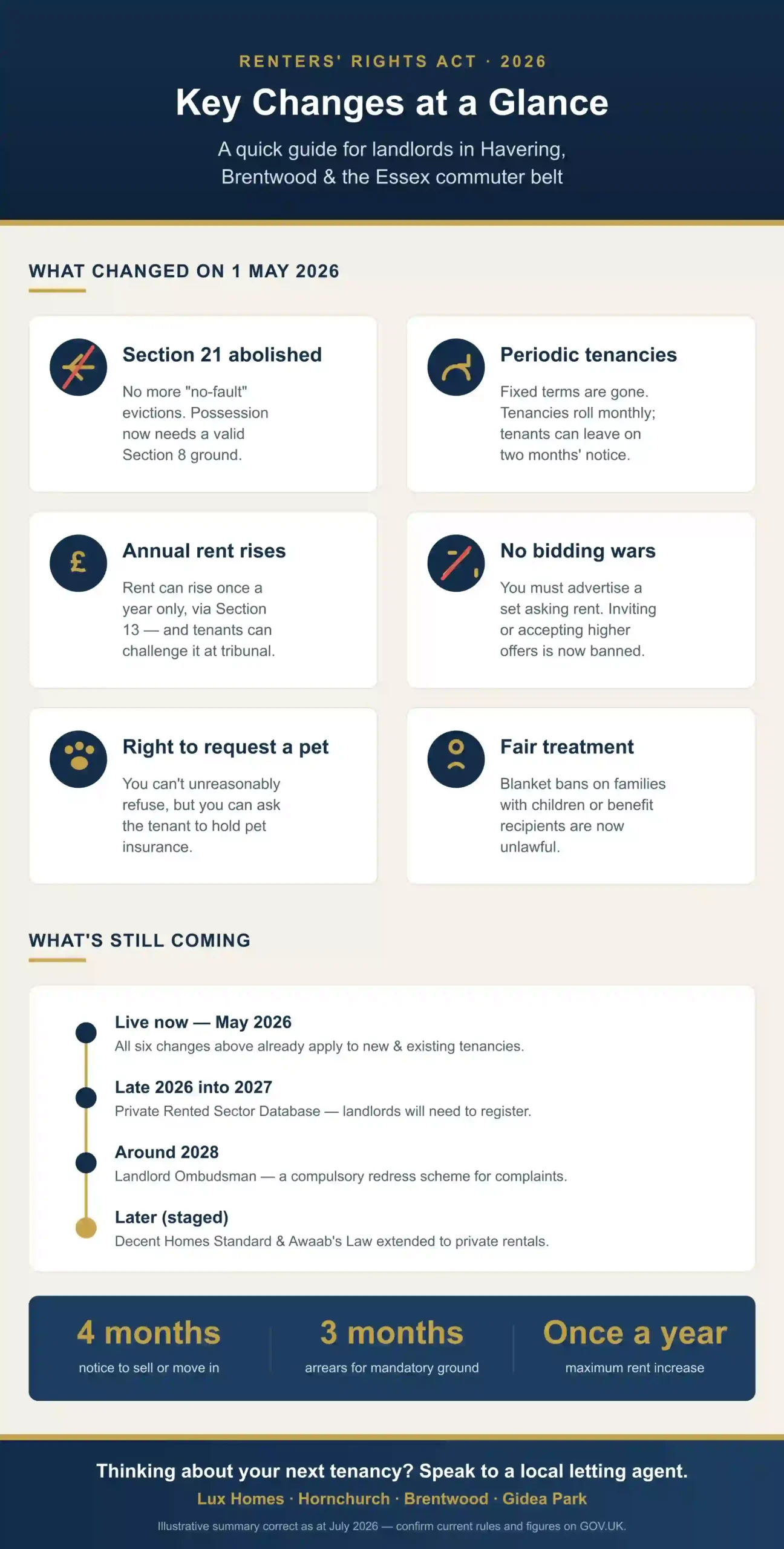
Figure 1: Renters’ Rights Act 2026 — key changes at a glance (high-resolution version supplied separately).
The end of Section 21 — and what replaces it
The single biggest change is the abolition of the Section 21 “no-fault” eviction. Since 1 May 2026 you can no longer ask a tenant to leave simply because a fixed term has ended or because you’d prefer them gone. Every possession claim must now rely on a specific ground under Section 8 of the Housing Act 1988, and you have to prove that ground to the court.
The grounds themselves have been reshaped. Some are mandatory, meaning the court must grant possession if the ground is proven; others are discretionary, meaning the court weighs up whether eviction is reasonable. The old Form 3 has been replaced by a new Form 3A, and the notice periods have been rewritten. Get the ground, the notice period or the paperwork wrong and the notice can be void on its face — which means starting again and losing months.
The Section 8 grounds you’ll actually use
Most landlords will only ever encounter a handful of grounds. These are the ones that matter most in practice.
| Ground | Purpose | Notice | Key conditions |
| Ground 1 | You (or a close family member) want to move in | 4 months | Can’t be used in the first 12 months of the tenancy; re-letting restricted afterwards |
| Ground 1A | You want to sell the property with vacant possession | 4 months | Can’t be used in the first 12 months; you can’t re-let or re-market for 12 months if the sale falls through |
| Ground 8 | Serious rent arrears (mandatory) | 4 weeks | At least 3 months’ arrears (or 13 weeks if paid weekly/fortnightly), met at notice and at the hearing |
| Grounds 10 & 11 | Some arrears / persistent late payment (discretionary) | 4 weeks | Court decides whether eviction is reasonable |
| Ground 14 | Anti-social behaviour | No minimum | Proceedings can begin immediately |
A few points worth stressing. The arrears threshold for the mandatory arrears ground has risen from two months to three months, and the notice period has grown from two weeks to four weeks. Arrears caused solely by a delayed Universal Credit housing payment are left out of the calculation. And because the arrears must still be at three months on the hearing date, a tenant who pays enough to drop below the threshold before the hearing can defeat the claim.
The move-in and sale grounds (1 and 1A) carry real financial teeth. Neither can be used in the first twelve months of a tenancy, both need four months’ notice, and if you use Ground 1A to sell but the sale collapses, you’re barred from re-letting or even marketing the property for a further twelve months. That restriction is designed to stop landlords using “I’m selling” as a back-door no-fault eviction — so it should only be relied on when the intention is genuine. Landlords bridging between a sale and an onward purchase sometimes look at how short-term bridging finance works to manage the gap.
Notice periods and grounds should be confirmed against the current statutory guidance before you serve anything, as they can be updated by regulation.
Fixed terms are gone — how periodic tenancies work
Assured shorthold tenancies no longer exist for new lettings, and existing ASTs converted automatically on 1 May 2026. Tenancies are now periodic assured tenancies — rolling arrangements with rent payable monthly and no fixed end date. A tenant can end the tenancy at any point by giving two months’ notice.
For landlords used to the reassurance of a signed 12-month term, this feels like a loss of certainty. In reality, most reliable tenants stay put for years regardless of what the paperwork says; the fixed term was never really what kept them there. What changes is the mechanism: your possession process and your record-keeping now have to be built around an open-ended tenancy rather than a term with a tidy end date.
There’s also a practical upside. Void periods are often driven by tenants leaving abruptly at the end of a fixed term. A rolling tenancy with a two-month tenant notice period can actually give you more warning to re-let, provided you’re set up to move quickly.
Rent increases, bidding wars and rent in advance
Three connected reforms change how money moves at the start of and during a tenancy.
Rent increases can now happen only once every twelve months, must be in line with market rents, and must follow the formal Section 13 procedure. Tenants can challenge an increase at the First-tier Tribunal if they believe it’s above market rate, and the tribunal can’t raise it higher than you proposed. In practice this means a single, well-evidenced annual review — informed by genuine local comparable rents — rather than informal top-ups.
Rental bidding is banned. You (or your agent) must advertise the property at a stated asking rent, and you can’t invite or accept offers above it. In a tight market like the Essex commuter towns, where good family homes near a station attract several applicants, this is a meaningful shift. The lever now is setting the right asking rent from the outset, not letting applicants bid each other up.
Rent in advance is restricted. Demanding large upfront payments once a tenancy has been entered into is no longer permitted. This particularly affects the way some landlords services used to secure tenants who might not pass referencing on income alone — a workaround that needs rethinking rather than a quick fix.
Pets, families and fair treatment
Tenants now have the right to request a pet, and you can’t unreasonably refuse. You can, however, require the tenant to hold pet insurance to cover potential damage, which is a fair middle ground for most landlords.
It’s also now unlawful to operate blanket policies that refuse families with children or people receiving benefits. For a fair-minded landlord these changes are less dramatic than they sound — they mostly formalise good practice and remove the “no children, no DSS” wording that was already falling out of favour. The practical takeaway is to assess every applicant on affordability and references, and to make sure any adverts and referencing criteria don’t discriminate.
What’s still coming — the implementation timeline
Not everything landed on 1 May 2026. Several significant measures are being phased in over the following years, and landlords who prepare early will find the transition far smoother.
| When | What | What it means for you |
| Live now (May 2026) | Section 21 abolished, periodic tenancies, new Section 8 grounds, rent rules, pet and anti-discrimination rules | The core reforms already apply to new and existing tenancies |
| Late 2026 into 2027 | Private Rented Sector Database (regional roll-out, then full) | Landlords will need to register; some possession grounds may depend on it |
| Around 2028 | Landlord Ombudsman | Compulsory redress scheme for tenant complaints |
| Later (staged) | Decent Homes Standard and Awaab’s Law applied to the private sector | Minimum property condition standards and strict repair timescales |
Exact dates for the database, Ombudsman and Decent Homes Standard are still being confirmed — treat the timeline as indicative and check GOV.UK for the latest.
The direction of travel is unmistakable: more registration, more accountability, and far less tolerance of poorly maintained homes. None of it is a problem for a landlord who keeps decent records and looks after their property — but it rewards getting organised now.
A landlord compliance checklist for 2026
Whether you manage your own lettings or use an agent, it’s worth checking these off before your next tenancy or at your next review.
- A written tenancy agreement reflecting the new periodic assured tenancy
- Tenants given the required written information about the tenancy before it starts (existing tenants should have received the Government information sheet by 31 May 2026)
- A valid, in-date gas safety certificate and Electrical Installation Condition Report (EICR)
- An EPC of the required minimum standard
- Deposit protected in an approved scheme within the statutory timescale, with prescribed information served
- Right to Rent checks completed and recorded
- Working smoke and carbon monoxide alarms tested and documented
- Any rent increase carried out via the correct Section 13 process, no more than once a year
- Adverts showing a fixed asking rent, with no invitation to bid
- Referencing and advertising criteria that don’t discriminate against families or benefit recipients
- A plan to register with the PRS Database once it opens
Missing any of these can undermine your ability to regain possession later, so the checklist is as much about protecting your position as it is about ticking boxes.
What this means specifically for landlords in Havering and Brentwood
The Essex commuter belt, from Hornchurch through to Brentwood, has long enjoyed steady rental demand. Tenants move here for more space than inner London can offer while keeping a realistic commute, and the mix of period homes, newer flats and family houses suits a broad range of renters — you only have to look at the homes currently available to rent locally to see the spread. That underlying demand hasn’t changed — but the margin for error has narrowed, which is where professional landlord services earn their keep.
Local nuance matters more than ever. The tenant profile for a two-bedroom flat near a station such as Gidea Park is very different from that of a three-bedroom family house on a quiet residential road, and each attracts a different asking rent. With bidding now banned, setting that asking rent accurately from day one — using real, current local comparables rather than a portal estimate — is what determines whether you let quickly at a fair figure or sit with an over-priced void.
Compliance also looks different property by property. Older housing stock, of which there is plenty across Havering and around Brentwood, will feel the eventual Decent Homes Standard and Awaab’s Law more keenly than newer flats. Getting ahead of maintenance now is cheaper than reacting to a complaint later. Getting ahead of maintenance now is cheaper than reacting to a complaint later, and larger refurbishments may involve regulated and unregulated development finance.

Self-manage or use an agent?
Plenty of Essex landlords have managed their own properties happily for years, and the new rules don’t automatically change that. But they do raise the stakes. Here’s an honest comparison of what each route now involves.
| Consideration | Self-managing | Full management via an agent |
| Legal compliance | You keep up with changing rules and paperwork yourself | The agent maintains compliance and updates processes |
| Serving notices | You must get the ground, form and notice period exactly right | Handled correctly on your behalf |
| Rent collection & arrears | You chase and manage arrears personally | Collected and chased, with a clear arrears process |
| Maintenance & repairs | You arrange and vet contractors | Coordinated, often through vetted contractors |
| Inspections & records | Your responsibility to schedule and document | Carried out and recorded to support your position |
| Time and stress | Significant, especially if issues arise | Largely removed |
| Cost | No management fee | A monthly management fee |
The honest position after May 2026 is that self-management carries more risk than it used to. A single mistake — a mis-served notice, a missed compliance step, a rent increase done the wrong way — can leave you unable to regain your property when you need it, or exposed to a penalty. That doesn’t mean everyone should hand over the keys, but it’s a fair moment to weigh the cost of a managed service against the value of the compliance and peace of mind it buys. For landlords who prefer a middle path, a tenant-find service that gets a well-referenced tenant in place, combined with your own day-to-day management, remains a sensible option.
Common mistakes landlords are making right now
A few recurring errors are worth flagging, because they’re easy to avoid:
- Assuming the fixed term still protects them. It doesn’t — tenants can leave on two months’ notice, and you can no longer end a tenancy just because a term “ends”.
- Serving the wrong notice. Section 21 is gone; using an old form or the wrong ground makes the notice invalid.
- Getting the arrears timing wrong. The three-month threshold must be met both when you serve and at the hearing.
- Inviting offers above the asking rent. This is now banned, even informally.
- Increasing rent more than once a year or outside the Section 13 process.
- Leaving maintenance to drift. With Awaab’s Law on the horizon, slow repairs will carry growing consequences.
Frequently asked questions
Can I still evict a tenant under the Renters’ Rights Act?
Yes, but only using a valid Section 8 ground — such as serious rent arrears, anti-social behaviour, or a genuine intention to sell or move in — and you must follow the correct notice period and prove the ground to the court.
Do I need to issue new tenancy agreements to existing tenants?
Existing tenancies converted automatically to periodic assured tenancies on 1 May 2026, so you don’t need to re-issue the agreement, but existing tenants should have been given the Government information sheet explaining the changes by 31 May 2026.
How much notice does a tenant have to give to leave?
Two months, at any point, regardless of how long they’ve been in the property.
Can I increase the rent?
Yes — once every twelve months, in line with market rents, using the formal Section 13 procedure. The tenant can challenge the increase at a tribunal.
How long before I can ask a tenant to leave so I can sell?
The sale ground can’t be used in the first twelve months of the tenancy, and requires four months’ notice after that. If the sale falls through, you’re restricted from re-letting for a further twelve months.
Is it still worth being a landlord in Essex?
Rental demand across Havering, Brentwood and the surrounding commuter towns remains steady. The reforms raise the bar on compliance and record-keeping rather than removing the case for letting — the landlords who fare best will be the organised ones.
A sensible next step
If you’re unsure how the new rules affect your particular tenancy, the most useful first move is a conversation with a letting agent who works in your area day to day — ideally alongside a current rental valuation, so you know exactly where your property sits in today’s market before you set an asking rent or plan your next tenancy. Understanding your position now is a great deal cheaper than fixing a problem later.