






































































3D Printing on Textiles: How It Actually Works, the Materials, and Whether It’s Really Sustainable
The idea of “3D-printed clothing” gets thrown around a lot, but most articles stop at the buzzwords — less waste, more customization — without ever explaining how a printer bonds plastic to fabric, which technologies and materials actually work, or whether the sustainability claims hold up under scrutiny. If you’re a designer, brand, or curious maker trying to understand what’s real and what’s marketing, that gap matters.
This guide fills it. We’ll cover how 3D printing on textiles physically works, the main printing technologies and where each fits, the materials that matter (and why TPU dominates), the real-world applications shipping today, an honest look at the sustainability case with actual numbers, and the challenges still holding the technology back. It’s the technical-but-readable explainer the topic usually lacks.
First, What “3D Printing on Textiles” Actually Means
There are two distinct things people mean when they say 3D-printed textiles, and confusing them causes most of the misunderstanding:
1. Printing directly onto existing fabric. Here, a printer deposits molten or cured polymer straight onto a woven or knitted textile, bonding to it to add texture, structure, decoration, or function. The fabric remains the base; the print is an addition.
2. Printing the “fabric” itself. Here, there’s no traditional textile at all. The printer creates a flexible, fabric-like structure from scratch — typically thousands of small rigid segments linked by hinges so the whole thing drapes and moves like cloth.
Both are additive manufacturing (building an object layer by layer from a digital file), and both matter for sustainability, but they work very differently. Let’s take each.
How Printing Directly Onto Fabric Works
This is the more accessible method, and increasingly doable even on modified desktop printers. The magic is in a mechanical bond, not glue.
When a flexible filament like TPU is heated and extruded onto a textile, it’s naturally tacky. As the printer pushes the melted polymer onto (and slightly into) the weave, it flows around and through the gaps between the fibres. When it cools and solidifies, it has effectively locked itself into the fabric’s mesh — forming a permanent bond that flexes with the cloth and resists peeling, even through wash cycles. Makers often call this the “sandwich” or “pause-and-print” technique: you print a base layer, pause the printer, lay the fabric onto the hot print, then resume so subsequent layers clamp the textile in place.
A few technical factors decide whether the bond succeeds:
- Fabric choice matters. Open-weave and mesh fabrics give the polymer more holes to grip; synthetics like polyester often bond better than cotton. Loosely woven textiles mechanically lock better than tight, smooth ones.
- Temperature control is critical. The print must be hot enough to bond but not so hot it scorches or warps the fabric.
- Flexibility must match. Rigid filaments like PLA sit on top of fabric like a hard shell — they restrict movement and peel off. Elastomers like TPU move with the textile, which is why they dominate wearables.
- Surface pre-treatment helps. In industrial settings, plasma or corona treatment of the fabric improves adhesion for technical textiles.
The Main Printing Technologies (and Where Each Fits)
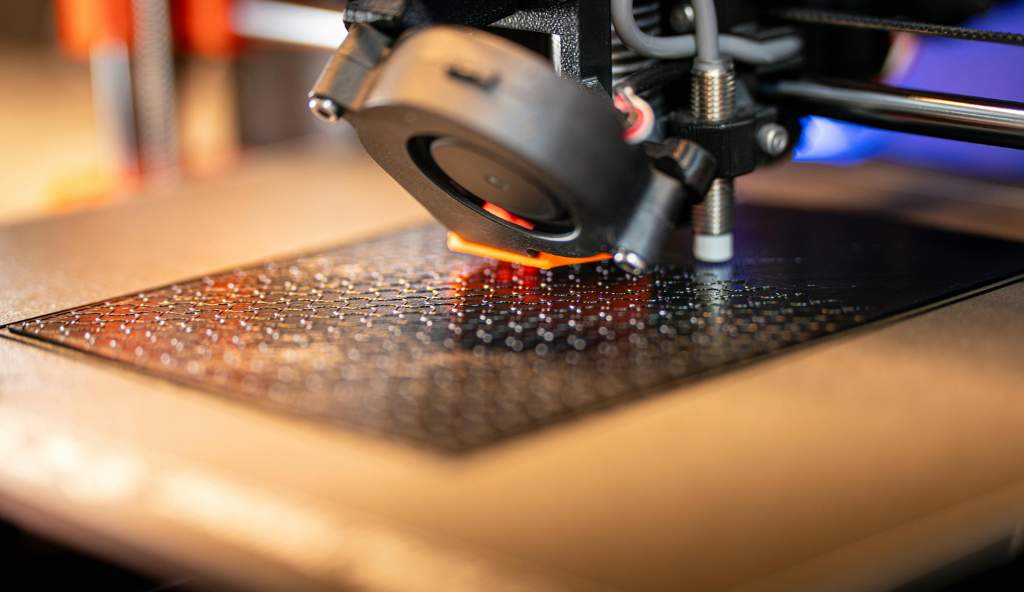
Not all 3D printing is the same. Four technologies show up repeatedly in textile work, each with a different sweet spot.
FDM / FFF (Fused Deposition Modeling)
The most common and affordable method — the one in most desktop printers. It extrudes molten thermoplastic filament layer by layer. For textiles, FDM is the go-to for direct-to-fabric printing with flexible filaments, prototyping, and DIY wearables. Its limits are resolution and, with cheaper setups, durability — DIY TPU prints may survive only a handful of wash cycles unless carefully cured and bonded.
PolyJet (Photopolymer Jetting)
An industrial method that jets liquid photopolymer resin and cures it with UV light, layer by layer. This is the high end of direct-to-textile printing: systems like Stratasys’s TechStyle line can print in full colour across hundreds of thousands of colour combinations and combine multiple material types — flexible, rigid, opaque, transparent — in a single print, directly onto fabric, eliminating hand-painting. Industrial PolyJet prints have been tested to withstand 50+ gentle wash cycles without significant delamination, far beyond typical DIY results.
SLS (Selective Laser Sintering)
Uses a high-powered laser to fuse powdered polymer (often nylon) into solid shapes, layer by layer, with no support structures needed. SLS excels at complex, interlocking geometries — which is how printed “fabrics” made of linked segments are produced. It’s precise and durable but industrial in cost.
MJF (Multi Jet Fusion)
Similar powder-bed approach, known for producing flexible nylon “textiles” built from many small rigid parts connected so they behave as continuous, draping material. A landmark example is Nervous System’s Kinematics Dress — made of thousands of triangular nylon tiles linked by integrated hinges, printed in a single folded piece with no assembly, yet flexing fluidly like cloth. (One version is held in New York’s MoMA.)
The Materials That Matter
Material choice determines whether a 3D-printed garment is comfortable, durable, and sustainable. The main players:
TPU (Thermoplastic Polyurethane) — The Workhorse
TPU is the most widely used filament for apparel, and for good reason. It’s an elastomer: highly elastic, returning to shape after deformation, with a low modulus that makes it comfortable against the body. It also absorbs shocks, resists tearing, and — importantly for outdoor wear — has excellent UV and moisture (hydrolysis) resistance, so it doesn’t quickly harden or degrade in sunlight. Its flexibility lets printed components move naturally like traditional textiles, which is why sportswear designers use it for elastic bands, shoe parts, and ergonomic supports, and why high-fashion houses use it for sculptural pieces.
Nylon — Strength and Structure
The backbone of powder-based (SLS/MJF) printed fabrics. Strong, durable, and able to form the intricate linked-segment structures that behave like cloth. It also takes dye well.
PLA (Polylactic Acid) — Eco-Friendly but Rigid
Derived from renewable sources like corn starch and biodegradable under the right conditions, PLA is popular for its ease of use and lower environmental footprint. But it’s rigid — poor for anything that needs to flex against the body, so it’s better for accessories, jewellery, and structural notions than for wearable “fabric.”
Recycled and Emerging Materials
This is where sustainability gets real (more below): recycled filaments made from post-consumer plastic, and experimental biodegradable options including algae-based filaments, are moving the material base away from virgin petroleum polymers.
The Design Workflow Behind a Printed Garment
One thing the hype rarely explains is that the print is only the final step — the real work happens in software. A 3D-printed textile begins as a digital model built in CAD or 3D-modelling tools (designers commonly use software such as Rhinoceros, along with parametric and generative-design plugins). For fabric-like structures, this is where the interlocking geometry — the thousands of segments and hinges that let a rigid material drape — is defined mathematically rather than sewn.
This digital-first workflow is a big part of the sustainability and customization story. Because the garment exists as a file, it can be:
- Parametrically resized to a specific person’s measurements before a single gram of material is used, cutting the fit-sample waste traditional fashion generates.
- Iterated virtually — designers test dozens of versions on screen instead of cutting physical prototypes.
- Optimized to use less material while keeping strength, increasingly with AI-assisted generative design that finds efficient lattice structures a human wouldn’t draw by hand.
- Stored and re-printed on demand anywhere there’s a compatible printer, enabling the distributed production model that cuts shipping emissions.
The model is then “sliced” into printable layers, print settings (temperature, layer height, speed, orientation) are tuned to the material and fabric, and only then does printing begin. Get the digital stage right and the physical print is almost a formality; get it wrong and no amount of good filament will save the result.
Real Applications Shipping Today
This isn’t purely futuristic. 3D printing already appears across fashion and function:
- Footwear is the biggest commercial success — printed midsoles and lattice structures let brands tune cushioning precisely. Adidas’s Futurecraft line brought 3D-printed components into mass-market performance shoes.
- High fashion and couture use it for sculptural, otherwise-impossible pieces — designers like Iris van Herpen are known for intricate 3D-printed artworks, and houses like Balenciaga have shown printed TPU pieces.
- Sportswear and wearables use printed elastic inserts, ergonomic supports, and protective elements that must bend constantly.
- Accessories and jewellery — a natural fit for smaller, detailed, customizable printed objects.
- Technical and functional textiles — even research into printing self-cleaning surface textures onto fabric, and NASA studying 3D printing to upgrade spacesuits.
The Sustainability Case — With Actual Numbers
The environmental pitch rests on real problems. The fashion industry is a major waste generator: globally, around 92 million tonnes of textile waste is produced each year, a figure projected to keep climbing. In the US alone, roughly 17 million tons of textile waste entered municipal solid waste in a single recent year, with only about 15% recycled. Traditional cut-and-sew manufacturing wastes material by design — offcuts from cutting patterns out of fabric rolls routinely exceed 15% waste per garment.
Here’s where additive manufacturing genuinely helps:
Less material waste. Because 3D printing builds up only the material needed rather than cutting shapes from a larger sheet, it can dramatically cut material consumption — by as much as 90% in some manufacturing contexts compared to subtractive methods. Even accounting for print failures and supports, the waste footprint can be far lower than cut-and-sew.
On-demand, distributed production. Printing garments only when ordered attacks fashion’s overproduction problem directly — less unsold inventory, less deadstock. And regional printing hubs closer to customers cut the transport emissions baked into today’s globalised supply chains.
Lower energy and emissions (in the right conditions). Analyses, including from the World Economic Forum, indicate additive processes can use less energy and produce fewer emissions than conventional manufacturing for suitable products.
Circular material loops. This is the most exciting frontier. Recycled feedstock — including chemically recycled polyester and post-consumer plastic turned into filament — allows closed-loop systems where a printed item can eventually be reprocessed into new filament. Projects using recycled filament for fashion (converting would-be waste into garments) demonstrate the circular model in practice.
But — an honest caveat. The sustainability benefit is not automatic. Early 3D printing leaned heavily on virgin petroleum-based polymers, which limits the environmental gain. 3D printing itself generates waste too: studies have put the share of prints or print material that becomes waste at anywhere from a third down to lower figures with good practice — not zero. Recycling TPU can slightly degrade its mechanical properties (though blending with virgin material can help), and many printed plastics aren’t easily recycled through normal municipal streams. The genuine wins come when 3D printing is paired with recycled or biodegradable materials, on-demand production, and a real end-of-life plan — not simply from switching to a printer.
The Challenges Still to Overcome
For all its promise, several real barriers remain before 3D-printed textiles go mainstream:
- Material limitations. The range of fabrics and filaments that print well and feel genuinely textile-like is still narrow. Printed material can be stiffer or less breathable than woven cloth, and comfort remains a hurdle for full garments.
- Cost and accessibility. Industrial printers and specialist materials are expensive, putting quality direct-to-textile printing out of reach for many smaller makers. Costs are falling but remain a barrier to widespread adoption.
- Durability and washability. Bond strength and wash resistance vary enormously between industrial PolyJet (50+ cycles) and DIY FDM (as few as a handful) — consistency matters for real clothing.
- Technical expertise. Getting good results demands real skill in materials, settings, and fabric preparation. Broader education and training are needed for the technology to scale.
- Speed. 3D printing is still slow compared to mass textile production, limiting it (for now) to premium, custom, or low-volume applications.
The Market Direction
The trajectory is clearly upward. The digital textile printing market was valued in the billions and is projected to roughly double over the second half of this decade, growing at double-digit annual rates. That growth is driven not just by novelty but by structural forces: extended producer responsibility regulations pushing brands toward accountability for waste, capital flowing into circular-economy models, and consumer demand for sustainable, personalized products. Add advancing biodegradable materials, better recycled feedstock, and AI-optimized designs that use less material, and the direction is set — even if mass-market printed clothing is still some years away.
For a broader overview of how 3D printing is being applied to create more sustainable textiles — the core advantages, current use cases, and future prospects — CountDeals has a useful companion piece on how 3D printing can help create sustainable textiles. It’s a good starting point if this technical deep-dive has you wanting the wider sustainability picture.