


































































My friend in Willoughby, a mild panic, last March, called me in. Her bath was running. It had happened to her two years ago; a plumber came, unclogged it in 20 minutes, and she had to pay $165 — that was that.
This time she wanted my opinion of it before calling anybody. I asked her 4 questions. At the third answer, I told her to call a plumber right away and he was going to be spending some time in the basement.
She was eventually forced to get a part of her main sewer line re-lined. Total cost: $4,800. Not the worst — but a far cry from $165. They had been there for weeks, the early indications. But she simply did not know that’s what she was viewing.
Soap and water cleaners are a problem with the drain. The signs of a simple surface blockage on the sewer might actually be very similar in the beginning to the signs of a structural failure in the sewer. Both have slow drainage. Both could create an odor. Both are annoying. However, the latter can run into the thousands — or tens of thousands if left long enough — and the former, at a few hundred dollars to fix.
This is how to interpret the difference before calling anybody!
Here are the steps to take: What Kind of Drain is It?
First, determine which drain is the problem. Each NSW home has two separate associated drains: sewer (carries wastewater from toilets, sinks, showers and washing machines to the Sydney Water or Hunter Water main) and storm water (carries rain water from the roof gutters, downpipes and surface drainage away from the property).
They don’t link together, and they fail in totally different ways. A stormwater blockage typically occurs as leaves, trash or root intrusion in the vicinity of a surface pit. A sewer blockage can range from a grease accumulation, on the kitchen line, up to a collapsed clay pipe 4 metres below ground.
If the problem occurs only when it rains and the water accumulates on the yard or runs over from gutters or the drainage grate doesn’t drain, then you are having stormwater problems. If the issue is present when you are turning on water inside the house, it’s sewer-side. The difference is significant because sewer clogs have a greater potential to speed up to large issue.
You will find seven signs and what they mean.You’ll discover 7 indicators and what these are.
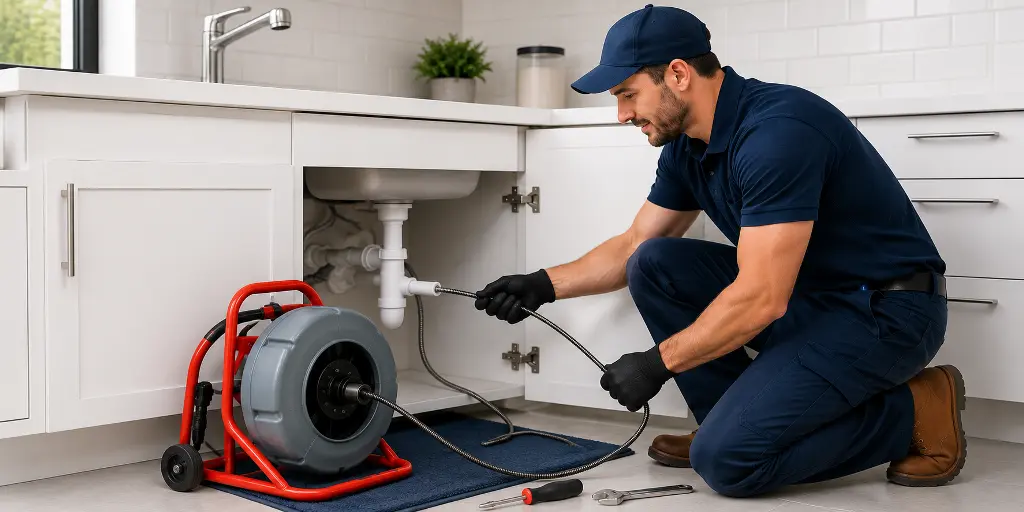 A plumber clearing a blocked sink drain using professional drain cleaning equipment.
Sign 1: One slow drain, and other symptoms are present
This is the optimum scenario. If there’s one slow drain in a normal home, it’s almost always just a clog in the branch line that supplies that fixture — either hair or soap scum or grease. A drain snake or quick jetting (under an hour typically) is typically the solution. Sydney prices range $165-$250 in the Sydney metro.
Know what to look for: if the same drain clogs again 6 months after they have been cleared, don’t treat the job as if it were a simple one. If it keeps happening at the same location, it’s likely that the problem is structural — a cracked joint, a partial collapse, or tree roots that are coming back in through a crack.
Sign 2: Drain gurgles when not used.
Any gurgling noise from a toilet or floor waste which has not been flushed recently is a pressure signal. It indicates that the system is pushing air through the trap, which is caused by water travelling through the system at another location. In simple terms, there is a clog in the sewer line (not the fixture, but further down the main sewer line).
An improvement on Sign 1. It isn’t a crisis but it’s the drain system saying something is closing the line. When left to itself, a partial blockage turns into a full blockage. Book it in the week and not the month.
Sign 3: Multiple fixtures are affected at the same time
When your toilet is slow, your shower is backlogged and your laundry sink is gurging, then it is not a branch pipe it’s a blockage in the main sewer line. The cost begins here as the main line will need to be accessed via jetting from an access point and the cause needs to be determined correctly.
In most cases, it is possible to make the line clear with high pressure drain jetting, but if you don’t know the cause of the blockage you are likely to be doing the same job in 6 to 12 months. This is where a camera inspection becomes a no-brainer.
Sign 4: The wet spot in the yard – and NO rain!
A patch that is damp, but no one can explain where it comes from – especially in a straight line from the house to the street or to a large tree – is a red flag. They may be a sign of a slow leak in the sewage from a leaky pipe in the ground. The pipe is not blocked, it is leaking because of a structural failure.
This one is urgent. Leaky raw sewage is a health, council compliance and property damage concern. It won’t resolve on its own. The surrounding soil may be damaged already if the pipe has been leaking for some time and the roots may be able to locate the water source.
Sign 5: Sewage smell on the premises, but in the house as well!
It’s not uncommon to smell a small amount near an external drain or inspection pit, especially during the summer months. If a sewage odor is detected inside the residence, near a waste pipe on the floor, under a sink or from a shower drain, then it is not the same. This is generally a sign of a dry-out in the trap (just add water) or just a break or some partial collapse along the line where gas is leaking.
If the smell persists after running water through the fixture and waiting 24 hours, then CCTV drain inspection services will be required to locate where the gas has leaked from. This cannot be found without the aid of a camera.
Sign 6: It has self-cleaned, but returns in days.
One of the most misunderstood drains is one that clogs, unclogs spontaneously, then clogs again. It’s like a small problem because it’s always getting solved. The actual problem is that the blockage is finally degrading to a level that water can flow through it but the root cause (tree roots, partial pipe deformation, a cracked joint) is still present. With every round of block and clear, the pipe is getting a little worse.
This pattern is typically noticed when it is already apparent that there is structural damage. In nearly all of these cases, this requires relining or even excavation (in the worst case scenario).
Sign 7: Water backing up out of the overflow relief gully can be seen.
Overflow relief gully is an external drain point at ground level in the yard close to the house that can overflow before sewage backs up in the property. If water or sewage is leaking out of it, the main sewer pipe from the house to the Sydney Water connection line is totally clogged or partially damaged.
This is a crisis situation! The system is already under strain and as the gully continues to build water pressure, backups will occur through the lowest fixture inside the house, typically a toilet or shower on the main floor. Do not book a service, but call for a 24-hour emergency drain service.
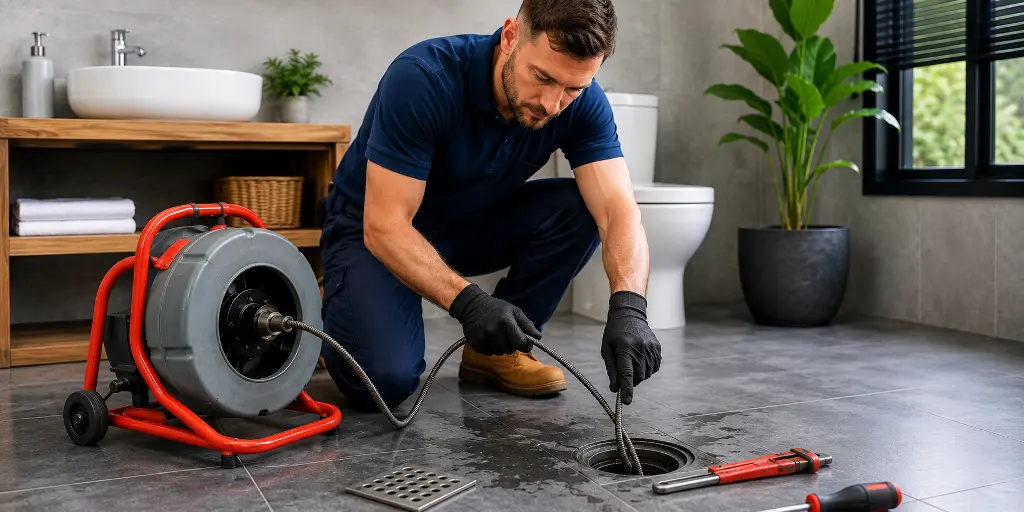 Professional drain unblocking using a flexible drain auger to clear a bathroom floor drain.
| Quick reference: how urgent is it? |
| Signs 1–2: Book within the week. Not urgent, but don’t ignore it. |
| Signs 3–4: Book within 48 hours. Structural issue likely. |
| Signs 5–6: Book within 24 hours. Camera inspection needed. |
| Sign 7: Call immediately. This is an emergency. |
Can the same symptom be caused by two different causes?
If you’ve got a slow shower drain in your 2019 townhouse in Bella Vista, it is a safe bet that the problem is caused by hair and soap scum build up, which is a case of a quick snake job and everything is done.
Lane Cove’s 1964 brick veneer with a slow shower drain may be the same. Or it might be that the clay pipe that brings water to that bathroom has cracked at a spot, 40% of the pipe diameter has been filled with root matter over the past two summers, and this is the downstream obstruction caused by it.
Same symptom. Completely different problem. The only way to find out which one you’re facing is to have a CCTV drain inspection carried out, which involves using a camera that is inserted into the pipe from an access point that provides real time feedback on the condition of the pipe and its contents.
That’s why a seasoned plumber will use a camera following a drain cleaning, not as a ploy to upsell you, but because it’s the only way to know that the symptom is gone if he didn’t use a camera. It doesn’t say anything about why it’s there or if it will be there in 3 months.
When does it really become a $10,000 Problem?
The truthful answer: If the pipe has structurally failed, and the only way to access the site is to dig it up.
Pipe relining may be possible if a camera inspection reveals a pipe that is cracked, has root intrusion at several joints, or has sections that are out of alignment but the pipe wall remains intact. Sydney standard residential reline costs $4,500 – $9,000, subject to length, diameter and number of junctions. No digging, no reinstatement, 50 year warranty.
If the pipe has completely collapsed, multiple sections are missing or the pipe has been affected to the degree that a liner cannot be inserted and inflated, excavation will be necessary. In Sydney, this includes concrete cutting (where applicable below a driveway or path), pipe laying (must be licensed) backfill, and surface reinstatement. The total cost is $10,000-$25,000 (plus access, depth and what’s on top of the pipe).
It’s almost always a matter of time between those two possibilities. A pipe that is caught during cracking, but still structurally sound, is a reline candidate. After roots have broadened the crack, ground movement has moved this section and pipe wall has further deteriorated, this one’s a dig job!
| Likely a reline job (lower cost) | Likely excavation required (higher cost) |
| Cracked joints with root intrusion | Fully collapsed pipe section |
| Partial pipe deformation | Multiple sections missing or crushed |
| Multiple joint failures — pipe intact | Pipe deformed beyond liner insertion |
| Recurring root blockage, same section | Sewage visible leaking at surface |
| CCTV shows damage but pipe holds shape | CCTV cannot pass through the pipe |
What to Do Right Now
If you’re reading this because the drain is a pain in your ass, the most helpful thing you can do now is to do everything you can to avoid waiting for it to solve itself.
Signs 1 and 2: Keep a few days – book something in the week.
Signs 3–6: Schedule a CCTV inspection before the plumber even gets to the drain. The video provides a baseline – what the pipe looks like now – that will also be useful in the event of a home insurance claim or when the problem is close to a boundary where a neighbour’s tree may be involved.
Stop reading this and call someone now – sign #7.
The common denominator that will be the same between a $300 outcome and a $12,000 outcome is the amount of time the problem ran before it was diagnosed properly. You can get a camera to tell you if you’re on that side or not, and the cost of the camera is a fraction of the cost of uncertainty if you wait.
This article has been contributed by Express Drain Cleaning team.