







































































Kitchen Renovation Costs in Melbourne: A Complete Budget Breakdown for 2026
The first question almost every homeowner asks before renovating a kitchen isn’t “what colour cabinets?” — it’s “what’s this actually going to cost me?” And it’s the hardest question to get a straight answer to, because renovation quotes vary wildly and most guides dodge the numbers entirely.
This guide does the opposite. It breaks down where the money actually goes in a kitchen design, what drives the price up or down, how to build a realistic budget, and the costly mistakes that blow budgets apart. Understand the cost structure first, and every design decision afterward becomes clearer.
The Three Renovation Tiers
Kitchen renovations broadly fall into three tiers, and knowing which one you’re planning is the starting point for any budget.
Budget / Cosmetic Refresh
This keeps the existing layout and plumbing/electrical in place, updating surfaces and fittings only: new benchtops, cabinet door replacement or repainting, new handles, splashback, tapware, and maybe flooring. Because you’re not moving services or structure, it’s by far the cheapest tier and the fastest to complete.
Mid-Range Renovation
The most common tier for owner-occupiers. This typically means new cabinetry, new benchtops, new appliances, updated lighting, and some layout adjustment — but generally keeping major plumbing and electrical roughly where it is. This is where most homeowners land when they want a genuinely new kitchen without structural work.
Premium / Full Renovation
A complete gut and rebuild: new layout, relocated plumbing and electrical, structural changes (removing or moving walls), custom cabinetry, premium appliances and finishes, and potentially engaging an architect or designer. This tier has the widest cost range because the ceiling is essentially unlimited.
Where the Money Actually Goes
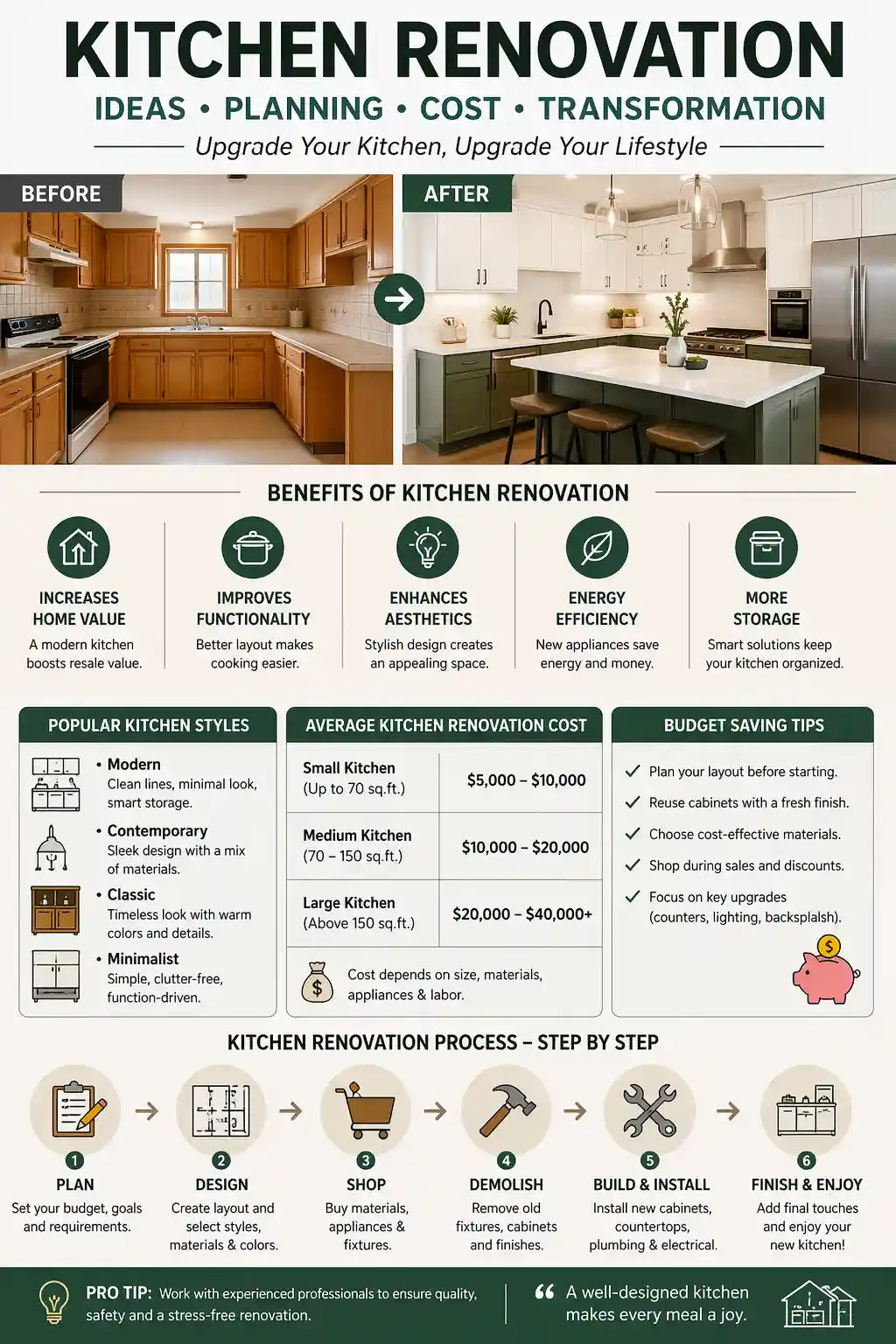
Regardless of tier, kitchen renovation budgets break down into fairly consistent proportions. Understanding these lets you see where to save and where not to.
Cabinetry (typically the largest single cost): Usually the biggest line item in any kitchen. Flat-pack is cheapest, followed by mass-produced modular, with fully custom cabinetry at the top. Cabinetry alone often accounts for a substantial share of the total budget.
Benchtops: The second major material cost. The material choice here (laminate vs natural stone vs porcelain) swings the price dramatically — and in Australia, engineered stone is no longer an option following the July 2024 ban, pushing buyers toward natural stone and porcelain.
Appliances: Ranges enormously depending on brand tier. A functional mid-range appliance package costs a fraction of a premium European suite.
Labour and trades: Cabinetmakers, plumbers, electricians, tilers, and the builder or project manager. Labour is a significant portion of any renovation and rises sharply the moment you relocate plumbing or electrical.
Flooring, splashback, tapware, lighting, and fittings: Individually smaller, but collectively meaningful — and easy to underestimate.
What Drives the Price Up
Several factors reliably push a kitchen renovation toward the top of its range:
- Moving plumbing or gas: Relocating the sink, dishwasher, or gas cooktop means new pipework and licensed trades — one of the biggest cost multipliers
- Electrical relocation: Moving or adding circuits, powerpoints, and lighting requires a licensed electrician and can involve switchboard work
- Structural changes: Removing walls (especially load-bearing ones) adds engineering, permits, and builder costs
- Custom cabinetry: Bespoke joinery costs considerably more than modular or flat-pack
- Premium materials: Natural stone, porcelain, solid timber, and high-end appliances all sit at the top of their categories
- Older homes: Renovating older properties often uncovers hidden issues — outdated wiring, plumbing that isn’t to code, uneven floors — that add unplanned cost
What Keeps the Price Down
Equally, several choices reliably reduce cost without necessarily compromising the result:
- Keeping the existing layout: Not moving the sink, stove, or fridge avoids the biggest cost multipliers entirely
- Modular or flat-pack cabinetry: Modern flat-pack has improved dramatically and costs far less than custom
- Laminate benchtops: A fraction of the cost of stone or porcelain, with convincing modern finishes
- Mid-range appliances: The performance gap between mid-range and premium is often smaller than the price gap
- Refacing rather than replacing cabinets: If carcasses are sound, new doors and hardware transform the look for much less
- Doing your own demolition and painting: Lower-skill tasks you can safely handle yourself reduce labour costs
How to Build a Realistic Budget
- Define your tier honestly. Be clear whether you’re doing a cosmetic refresh, a mid-range renovation, or a full rebuild. Mixing premium finishes into a budget scope is the fastest way to overspend.
- Get multiple itemised quotes. Insist on line-by-line breakdowns (cabinetry, benchtops, appliances, each trade) rather than a single lump sum. This is the only way to compare quotes meaningfully and spot where you can trim.
- Add a contingency of 10–20%. Renovations — especially in older homes — reliably uncover surprises. A contingency isn’t optional; it’s the difference between a stressful renovation and a manageable one.
- Prioritise spend by longevity. Put money into the things that are expensive to change later (layout, cabinetry carcasses, plumbing) and save on things that are easy to swap (handles, tapware, light fittings).
- Confirm what’s included. Clarify whether quotes include demolition, rubbish removal, appliances, tiling, painting, and finishing. “Excludes” lines are where budgets quietly balloon.
The Costly Mistakes That Blow Budgets
- Changing your mind mid-project: Variations after work begins are expensive. Finalise the design before trades start.
- Under-scoping the electrical and plumbing: These are the hidden cost drivers; get them assessed early.
- Choosing finishes before setting a budget: Falling in love with a premium benchtop before you know your numbers leads to overspending elsewhere.
- Skipping the contingency: The single most common reason renovations run over.
- Not planning the layout properly: A poorly planned layout wastes money on rework and leaves you with a kitchen that doesn’t function well day-to-day.
That last point is the most important, because it’s where cost control and good design meet: the layout decision determines both how much you spend and how well the kitchen works for the next decade.
Design and Budget Go Hand in Hand
A realistic budget is only half the equation. The other half is spending it wisely — on a layout that works, storage that maximises your space, materials that last, and lighting and appliances suited to how you actually cook. Get the design decisions right and every dollar in your budget works harder.
CountDeals has a practical, well-structured guide covering exactly these decisions: layout planning and the work triangle, maximising storage in smaller kitchens, choosing durable materials, and getting lighting and ventilation right. If you’re moving from budgeting into actual planning, their guide to smart, efficient kitchen renovation is a useful next step to make sure your budget translates into a kitchen that genuinely works.