



































































Most people, when they get a big electricity bill, start thinking about solar panels, new appliances, or switching retailers. They budget for it, research for weeks, wait for a good deal. Meanwhile, there’s a small dial on their hot water system doing something it’s probably been doing for years — quietly burning money in the background.
Hot water accounts for around 25–30% of the average Australian household’s energy bill. It’s the second-biggest energy draw in most homes after heating and cooling. And yet almost nobody touches the settings after installation. The thermostat gets set during the install, the tradie leaves, and that’s usually where it stays — for the next 10 or 15 years.
The change we’re talking about takes about five minutes. No electrician, no parts, no spend. Just knowing what to look for and what to do with it.
Table of Contents
ToggleWhat’s Actually Happening Inside Your Hot Water System
Storage hot water systems — whether gas or electric — work by heating a full tank of water up to a set temperature and holding it there until you need it. Every time the water cools slightly, the system fires up again to reheat it. This is called standby heat loss, and it’s happening 24 hours a day whether you use hot water or not.
The higher the thermostat is set, the more energy the system uses to reach and hold that temperature. Most storage systems in Australian homes leave the factory set to around 60–65°C for legionella safety reasons — which makes sense. What doesn’t always make sense is where the dial ends up after installation, or how the system is timed if you’re on a controlled-load electricity tariff.
These are two separate things, and both are worth checking. Start with the simpler one.
The Thermostat Setting (Electric Storage Systems)
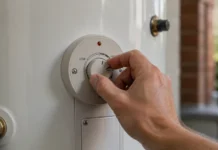
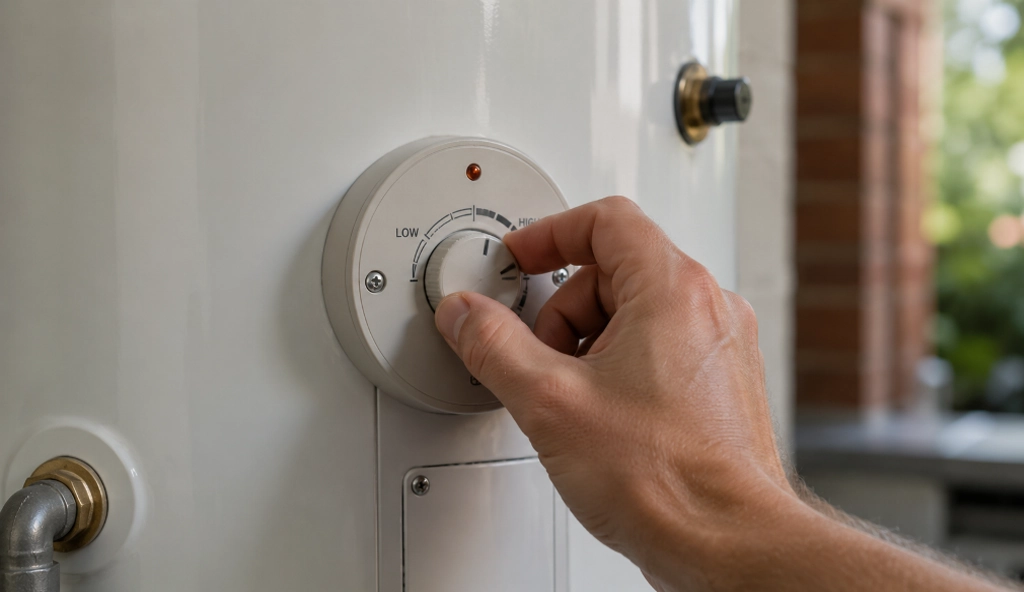
On most electric storage hot water tanks, there’s a small access panel near the bottom of the unit — usually a rectangular plastic cover held on by a single screw or clip. Behind it sits the thermostat dial. On older units it’s a physical dial you can turn by hand. On newer units it may be a dial with click-stops or a small adjustment screw.
The recommended setting for Australian households is 60°C. This is the minimum temperature required to suppress legionella bacteria in a storage system. Going lower than 60°C isn’t recommended for health reasons. Going higher than 60°C is where you’re wasting energy.
If your dial is sitting at 70°C or 75°C — which happens more often than you’d think, either because the installer set it high out of habit or a previous owner nudged it up — your system is heating that entire tank to a higher temperature than you need, every single heat cycle, every day.
At 70°C, your system works measurably harder than at 60°C for zero additional benefit at the tap. The mixing valve on your shower or kitchen tapware dilutes the heat back down anyway. You’re paying to overheat water you then cool before using it.
Turning the dial from 70°C down to 60°C on a typical 250-litre storage system reduces the energy needed per heat cycle. For a household that runs three to four heat cycles a day, the cumulative effect across a year is real, consistent, and requires nothing beyond that initial adjustment.
How to find and adjust the thermostat
- Turn off the power to the hot water system at the switchboard before opening the access panel.
- Locate the access panel — typically at the lower front of the tank, about knee height. On some units it’s on the side.
- Remove the cover. The thermostat dial or adjustment point will be visible. The current temperature setting is usually marked.
- If the dial is above 60°C, turn it down to 60°C. Do not go lower.
- Replace the cover, restore power, and leave the system to run normally.
- If there’s no marking on the dial at all, or you’re unsure what you’re looking at, call a licensed plumber rather than guessing — adjusting the wrong component can affect the safety cutout.
If your system is connected to Infinity Hot Water’s hot water maintenance service, a licensed tech can check and adjust the thermostat setting during a routine maintenance visit alongside the anode rod, pressure relief valve, and tempering valve checks.
The Thermostat Setting (Gas Storage Systems)
Gas storage systems have a similar thermostat, but it’s usually accessed differently. Most have a dial on the gas valve itself — located at the front or bottom of the unit behind a small cover. The positions are typically marked with words rather than numbers: ‘Pilot’, ‘Low’, ‘Hot’, ‘A’ (or ‘Very Hot’).
The ‘Hot’ position on most Australian gas storage units corresponds to roughly 60°C. The ‘A’ or ‘Very Hot’ position pushes to 70°C or beyond. If your dial is sitting on ‘A’, moving it back to ‘Hot’ is the adjustment.
Gas thermostats don’t need the power turned off before adjusting — the dial is mechanical — but if you’re at all unsure about what you’re looking at on a gas unit, leave it to a licensed gasfitter. Gas systems have more components near the thermostat (including the gas valve and pilot assembly) and it’s not worth the risk of accidentally disturbing something.
The Controlled-Load Timer (Electric Systems Only)
This is the second setting that a surprisingly large number of Sydney households have never looked at — and it’s where the bigger saving often lives.
Controlled load (also called off-peak or Economy 7, depending on your retailer) is a separate electricity tariff that runs your hot water system at a lower rate during specific off-peak hours — typically overnight between 10 pm and 7 am. The system heats the tank during those cheap hours, and the insulation holds the heat until you need it through the day.
The problem is that many households ‘on’ controlled load are not actually using it correctly. There are two common situations:
The tariff is active but the timer is wrong
Your switchboard has a controlled-load circuit for the hot water system. But the timer that controls when that circuit switches on — sometimes a physical dial on the switchboard, sometimes managed by your retailer remotely — is set to a window that doesn’t match the cheap-rate hours for your current plan. The system heats at what it thinks is off-peak time but is actually billing you at peak rate.
Check with your electricity retailer what hours your controlled-load tariff actually runs, then confirm with a licensed electrician that your switchboard timer matches those hours.
The tariff exists but was never activated
Some homes have a dedicated hot water circuit on the switchboard labelled ‘HWS’ or ‘Hot Water’ that was wired for controlled load during construction but never connected to the tariff by the electricity retailer. The system runs on the standard rate 24 hours a day. Calling your retailer and asking whether your property has a controlled-load connection available often reveals this.
Switching a correctly-wired hot water system from an all-day standard tariff to a controlled-load off-peak tariff is one of the most effective changes a Sydney homeowner can make. The system does exactly what it did before — you just stop paying peak rates for it.
What This Doesn’t Fix
Being honest about this: thermostat and timer adjustments improve efficiency on whatever system you already have. They don’t change what the system fundamentally is.
If your hot water system is more than 10 years old and you’re on a standard electric storage system, the standing heat loss is built into the design of an older unit. The thermostat fix helps, but a newer system — particularly a heat pump, which works on an entirely different principle and uses a fraction of the electricity per litre heated — will outperform any setting change on the old unit.
Similarly, if your system is undersized for your household and you’re running out of hot water during peak use, adjusting the thermostat won’t solve that. That’s a capacity problem that needs a different conversation.
And if your hot water bill has spiked suddenly rather than being consistently high, a setting adjustment is unlikely to be the cause. A sudden spike usually points to a failing element, a faulty thermostat that’s running continuously, or a slow internal leak — all of which need a licensed plumber rather than a dial adjustment.
The Honest Summary
Checking and adjusting your hot water thermostat to 60°C and confirming your controlled-load timer is correctly configured are the two highest-return, zero-spend changes most Sydney homeowners can make to their hot water running costs. Neither requires a tradie visit, neither voids a warranty, and both can be done on a Saturday morning in the time it takes to make a coffee.
If you open the access panel and find the setting is already at 60°C, or if your system is gas continuous flow rather than storage (continuous flow systems don’t have a tank to overheat — they heat water on demand), this particular tip doesn’t apply to you. But it’s still worth knowing what’s on your switchboard and what tariff you’re actually being billed on.
For anything beyond the dial — a system that’s misbehaving, a bill spike that doesn’t make sense, or a unit that’s more than a decade old and due for an assessment — the Infinity Hot Water team covers Sydney, the Central Coast and Newcastle and can run through the full system health check to tell you what’s worth fixing and what’s worth replacing.
This post is written by Infinity Hot Water team.